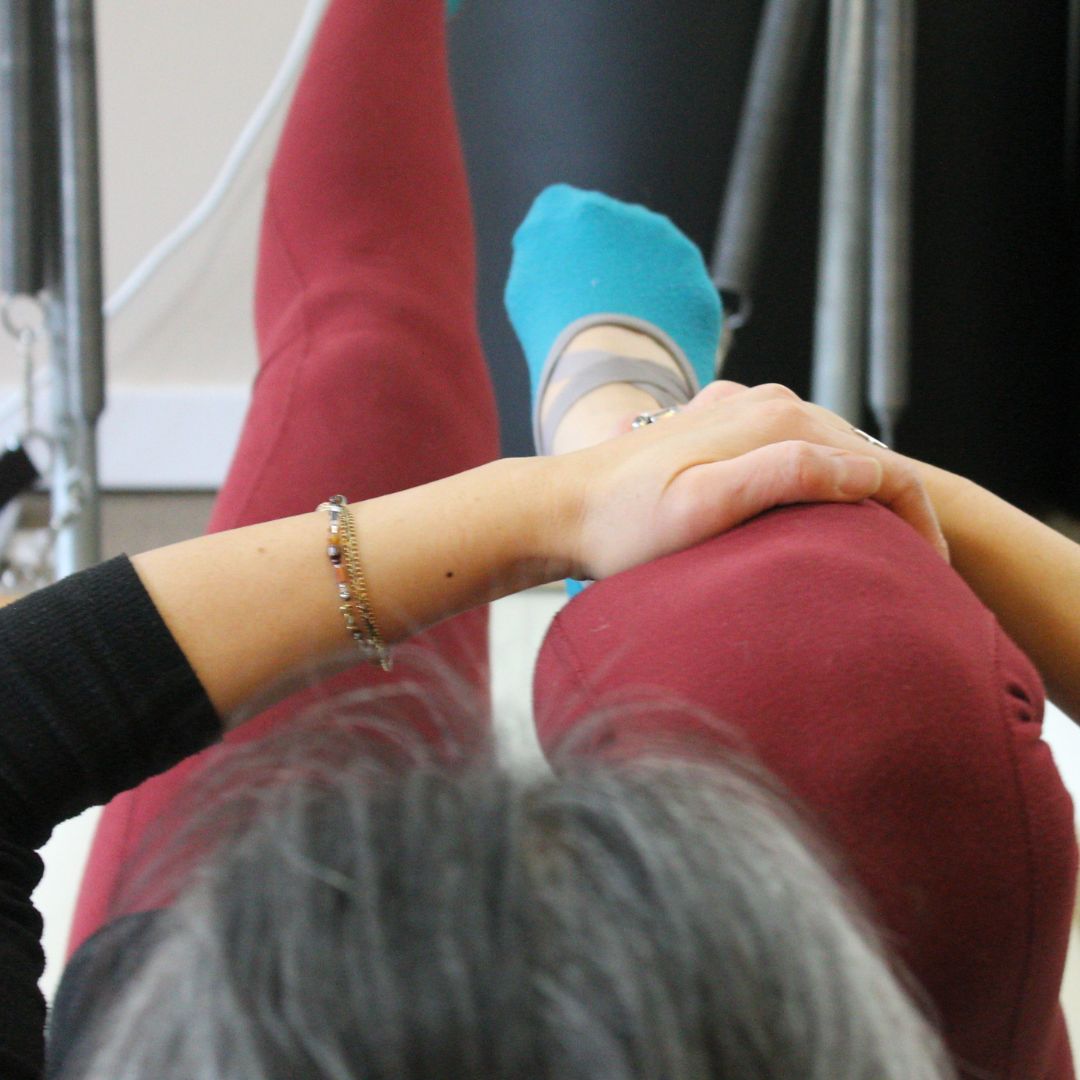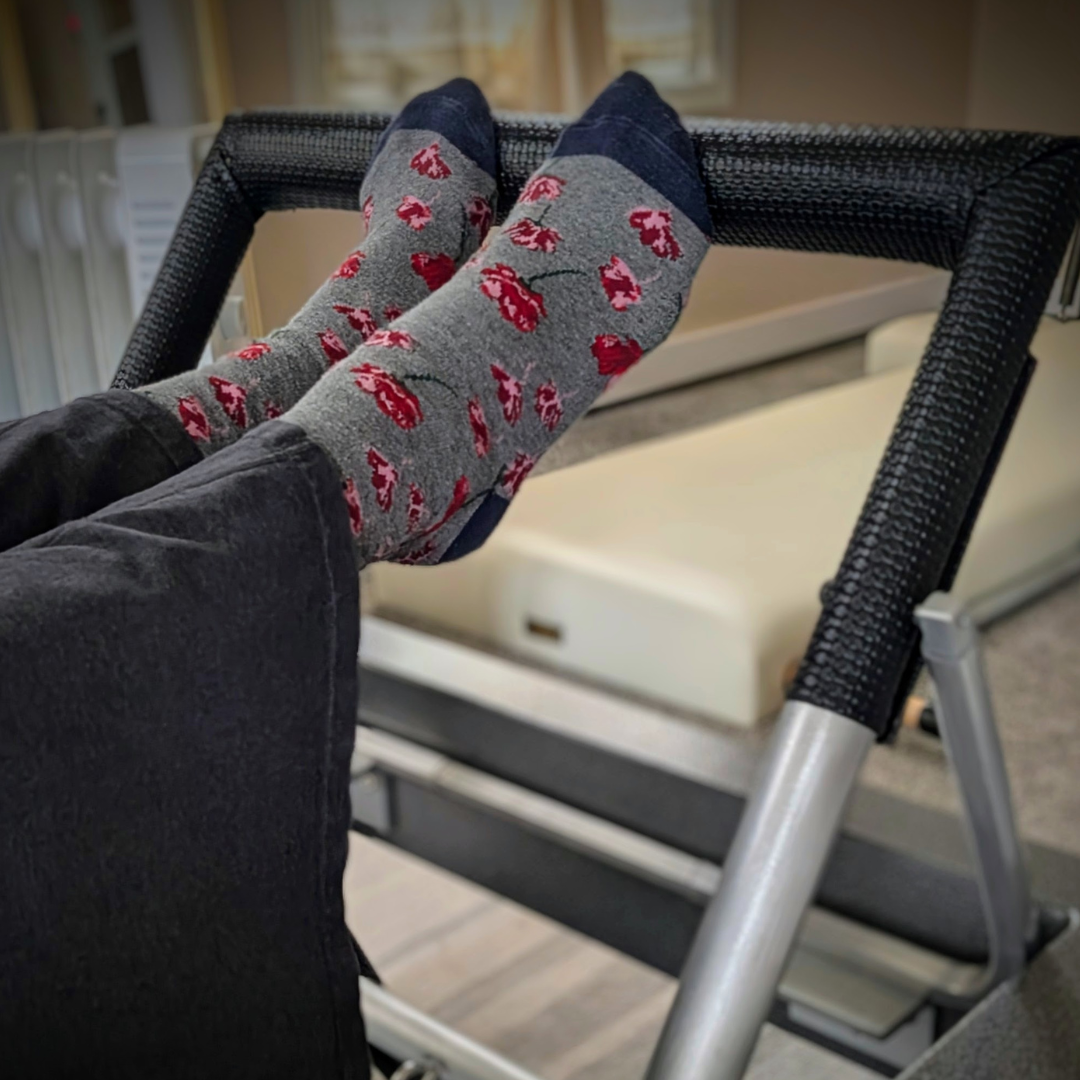
Pilates V on the foot bar for Footwork 1
What is Footwork? The Secret Behind The Four-Part Series On The Reformer
If you came home one day with a Rolls Royce, would you park it in your garage and just leave it there untouched? I often hear from clients that the Wunda chair they bought has become their wardrobe chair, or the reformer has been parked in the darkest corner of the basement, so of course they won’t use it. I know it’s difficult to be motivated and work out consistently—especially at home, where you get pulled in a million different directions. But not to despair, there is a workaround, and it starts with Footwork!
Pilates Every Day
How can a mere five minutes doing Footwork amount to anything? Let’s back up for a second. Pilates exercise –called Contrology back in Joseph Pilates’ day– was created as a form of daily practice. Even if you can’t do a full workout, there is still something you can do on a regular basis. Striving for daily discipline was part of Joseph Pilates’ philosophy. He believed in the betterment of humanity one workout at a time. If you can’t check in daily, the key to your Pilates success is to build consistency. Doing small things consistently yields better results than an all-or-nothing approach. This way, you stretch your investment in Pilates and in your own fitness and well-being.
Practice What You Teach!
My daily footwork practice started when I started practicing what I taught. A client I work with was progressing quickly from lesson to lesson and I wanted him to stay conditioned between lessons, even if it meant doing five minutes daily on his reformer at home. The perfect exercise to fill this length of time is the Footwork series. So after a couple times of repeating the same advice, I took my own advice and made it a priority to practice footwork every day. This simple effort drove home the fact that small steps lead to big gains. The daily footwork practice also gave me insights into every exercise that follows on the reformer. If Pilates is a system across all pieces of apparatus, then the same applies to the reformer order. In the end, Footwork is not simply a warmup, but the start of all your connections on the reformer.
Footwork is Bodywork
If you really set yourself up correctly for Footwork on the reformer, then this series is less about the feet and has everything to do with your whole body. The Pilates V position on the foot bar will set you up for muscle activation in your legs, glutes, powerhouse, upper back, neck, arms and hands. In a word: everywhere. The activation, however, is not the bracing or tightening you use for a heavy powerlift at the gym. On the reformer, the springs will support you, so you work your muscles in tandem with them: as the four springs attached under the foot bar and into the carriage open, you get increased resistance; as the springs close, that resistance decreases. When the springs open, your muscles work harder against the resistance. As the springs close, the resistance transfers to your powerhouse so you don’t bang the carriage against the stopper. Simply opening and closing the carriage involves more than just pushing your feet into the foot bar. The springs demand more engagement and your mind is occupied with calibrating the precise amount of muscle activation.
The Different Foot Positions
In addition to opening and closing the carriage, you use three different foot positions:
- First, you have the Pilates V, as mentioned above. The biggest challenge of this position is keeping your heels squeezed together and maintaining that stability, so you avoid pushing them under the foot bar as you straighten your legs.
- Next, you have Arches on the foot bar. It’s not easy to keep everything glued together along the mid-line. This position requires the unusual combination of simultaneously flexing the ankle and pointing the toes.
- The next position is with the heels on the foot bar, with the ankles flexed. Your feet and legs are in parallel position and glued together at the mid-line, as best as possible.
Moving through these various positions is beneficial for the feet and ankles. Therein lies the secret behind the Footwork series: the ankle mobility you gain here directly impacts your balance and coordination. Footwork provides a way to mobilize the fascia in the soles of the feet. While generally done on four equally weighted springs on a classical reformer, the Footwork setup can be adjusted according to each person’s needs. This affects spring settings or slightly different foot and leg positioning.
The Footwork series ends with Tendon Stretch, which always throws beginners. After 30 reps of bending and straightening your knees, here you keep your legs straight and point and flex through your ankles and feet (yes, that’s the simple explanation). Once you get the rhythm and coordination for the footwork series, you will switch from Footwork to Tendon Stretch with no hesitation.
What Does Each Foot Position Do For You?
Now, let’s dive a bit deeper into each foot position. Each part of Footwork targets different parts of your legs, which in turn work with the rest of the body. In Pilates, we look at the whole body, instead of isolating body parts. Ultimately, Joseph Pilates’ goal was to uniformly develop the whole body. This is true of the Footwork series on the reformer. In the first Pilates V foot position, the heel squeeze helps you connect from head to toe. In this position, are you lengthening? Are you connecting to your powerhouse? In the second and third foot positions (arches and heels), the challenge is in keeping the toes and knees glued together. You will feel this in your inner thighs. The third position, with heels on the foot bar, challenges the glutes, especially if you are really connected through your center. With small changes, you adjust how intensely you feel this movement in your glutes. In Tendon Stretch, you move your ankles through all three positions while keeping your toes on the foot bar. When done correctly, Footwork works your whole body and prepares you for the rest of your workout.
What About The Rest Of Your Body?
Footwork is influenced by your whole body alignment. It’s important that your head, shoulders and hips are centered on the carriage, in line with your feet, which are centered on the foot bar. The carriage, headrest, and shoulder blocks become props rather than resting points for your body, as you gently press into them with your head, shoulders and the back of your ribcage, and your hands. Even before you press the carriage out, you can activate all the muscles along the back of your body ever so slightly. Just the tiniest bit will change how you feel Footwork in your body.
Abs of Steel?
So, isn’t Pilates all about a strong core, and doesn’t that mean abs of steel? Not quite. Unless we’re talking stainless steel springs! The reformer springs are made of thick wire wound in coils. They offer the best metaphor for how our muscles and, in particular, our powerhouse should feel throughout a Pilates workout. It should lengthen and recoil, like the springs of the apparatus. The abs work as the springs open and close. There is no rigidity or exertion, just what I call a “constant simmer.” The way you work your center determines how the springs open and close. The happy marriage of the springs and your powerhouse literally changes the sound of the reformer. When you push with your legs only, you miss the ab connection. When you engage your powerhouse to open and close the carriage, you feel muscle activation and stretch at the same time. An engaged powerhouse also means that your backline (i.e., glutes and hamstrings) is activated. Which brings me to the next question:
What About My Glutes?
If you are used to doing glute bridges, squats and fire hydrants for your glutes, I imagine you will be surprised at how effectively footwork builds strength in your abs and glutes, all while lying down. How can this be? In pictures, it looks you are lying comfortably on the reformer, but with classical Pilates, you constantly move through different positions. While it’s true that you start lying down, after Footwork, you might sit up or go into inversion, depending on your level or the workout you choose. During Footwork, you need to be engaging —not clenching— your glutes. After all, Footwork gives you 30 zero-gravity and low-impact squats with variable resistance thanks to the springs.
Tendon Stretch, at the end of Footwork, is much more than a foot and ankle exercise. The glutes play an important role in stabilizing your knees as your press your heels under the foot bar and pull them towards the carriage. The closest exercise I can compare Tendon Stretch to is standing calf raises, however, this creates a misunderstanding, since it’s much more than a calf exercise. It is literally, as the name states, a stretch for the tendons. Because Joseph Pilates favors dynamic stretches, this exercise strengthens your feet, ankles and powerhouse, all while you stretch from head to heel.
Mind Over Body
Joseph Pilates was not only interested in uniform development of the body, but also the connection between the mind and the body. His equipment offers us a playground in which to test out the apparent contradiction of pushing less and developing all the muscles of our body. His exercises are a great challenge for your mind and body, making them the best way to clear your mind, and find new muscle connections in your body. You will feel great after doing your Pilates, whether you do 30, 40 or 50 minutes or even as little as five minutes every day. With all these benefits, footwork alone can gradually change your body over the course of months. And if footwork can do that, think how much more a full Pilates workout will do for you!
Check out Explore Pilates
You can try Pilates with me in person or online! I also have a video that shows you how to practice footwork at home with a small core ball (click here). Let me know how it feels in the comments! And because Pilates is a system, which exercises benefit from practicing Footwork? Just some food for thought!
Happy Footworking!
~A.
Read More About
- Is 20 Minutes A Day Of Pilates Enough
- Mastering The Art Of Breathing: A Comprehensive Guide To Better Health
- Three Lies You Might Tell Yourself Before Your First Pilates Class
- Busy Mom Trying to Fit In Your Workout? Pilates Is The Best Solution
- Summer Is Calling! Five Tips To Staying Fit This Summer
- More Than A Workout: The Mental Benefits Of Pilates Practice